
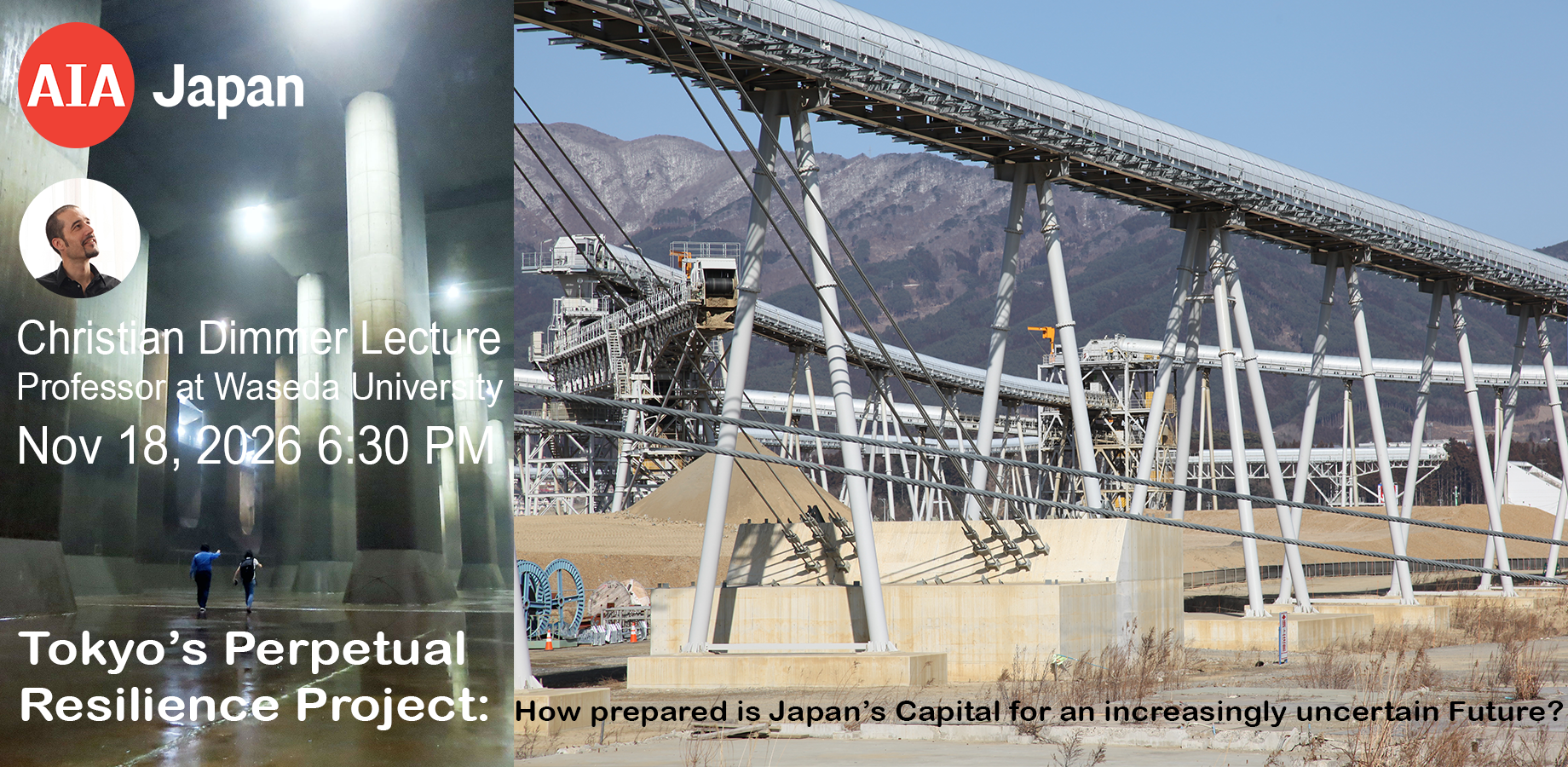
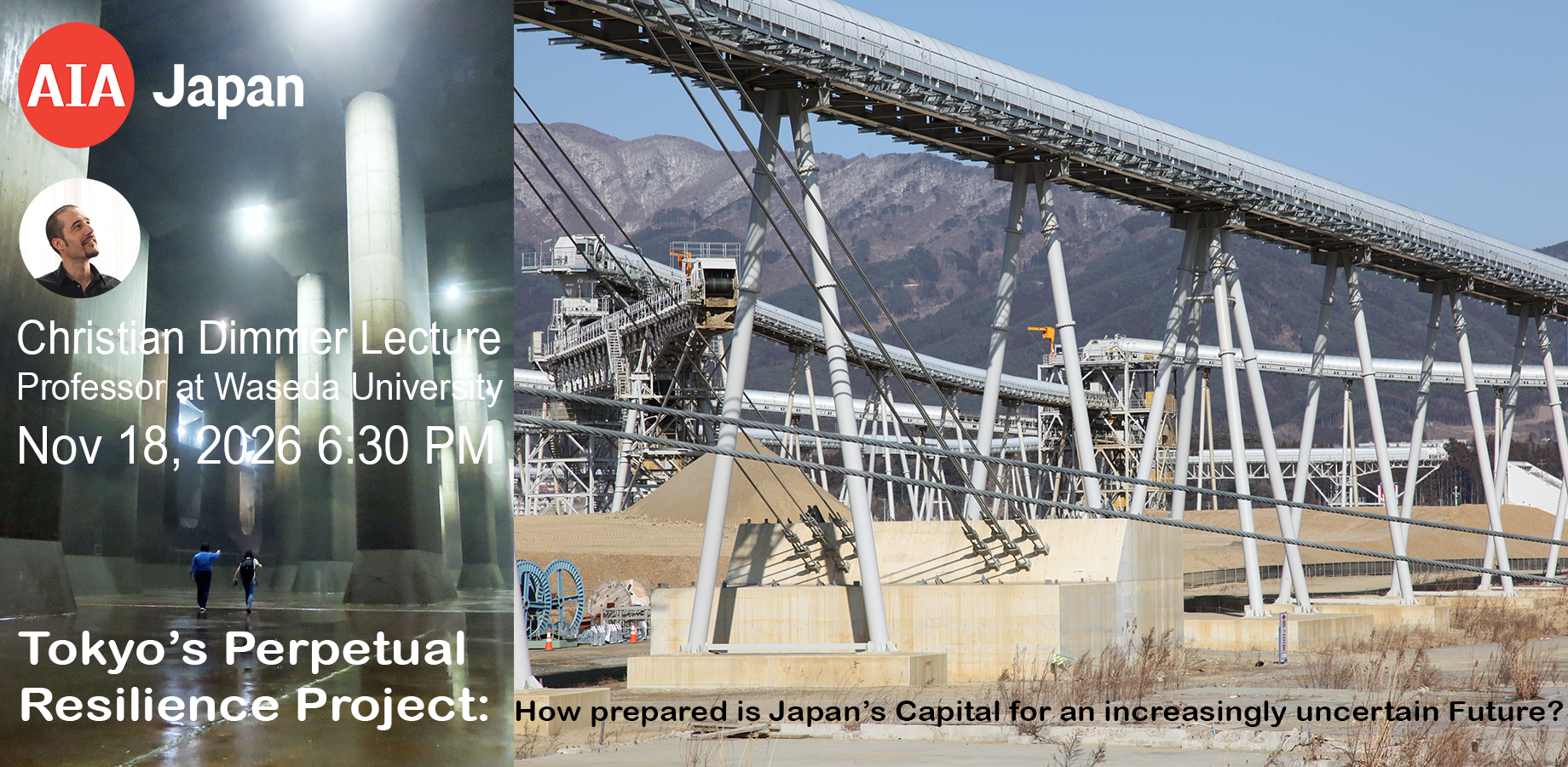
AIA Japan — Christian Dimmer: Tokyo’s Perpetual Resilience Project
When: Thursday 5 November 2026 @ 05:30 (Eastern US time)/ 18:30 (Japan time)
Where: Hybrid: ONLINE / In-Person: Venue to be announced
CES: Estimated 1.5 LU/HSW for AIA Members
Speaker
Christian Dimmer, Associate Professor, Transition Design and Urban Studies, Waseda University.
Description
Christian Dimmer examines how Tokyo has adapted to repeated disasters, environmental pressures and rapid urban transformation, asking what the city's experience can teach us about building resilience in an increasingly uncertain future.
Using the recently launched Tokyo Resilience Project (TRP) as a starting point, the lecture considers how the Japanese capital is preparing for the challenges of the next century. Introduced on the centenary of the 1923 Great Kantō Earthquake, the initiative identifies five major threats and sets out a long-term vision for a safer, more sustainable city.
The presentation traces the evolution of Tokyo's approach to resilience, from a pre-modern culture that accepted disasters as an inevitable part of urban life and prioritised rebuilding through local initiative, to modern, state-led strategies centred on engineering and technical expertise. While these approaches have brought significant advances, they have also tended to marginalise community participation and local knowledge.
Through a critical examination of the TRP, Dimmer questions the limitations of top-down planning, fragmented institutional coordination and the lack of meaningful civic involvement in addressing complex urban challenges. Drawing on ecological systems theory and Jane Jacobs's vision of urbanism, he makes the case for more adaptive and participatory models of governance, where community agency, interdependence and bottom-up innovation are central to resilience.
Ultimately, the lecture argues that urban resilience goes beyond infrastructure and technical solutions. It also depends on political choices, collective knowledge and the capacity of communities to shape their own responses to change.
Free to attend.