
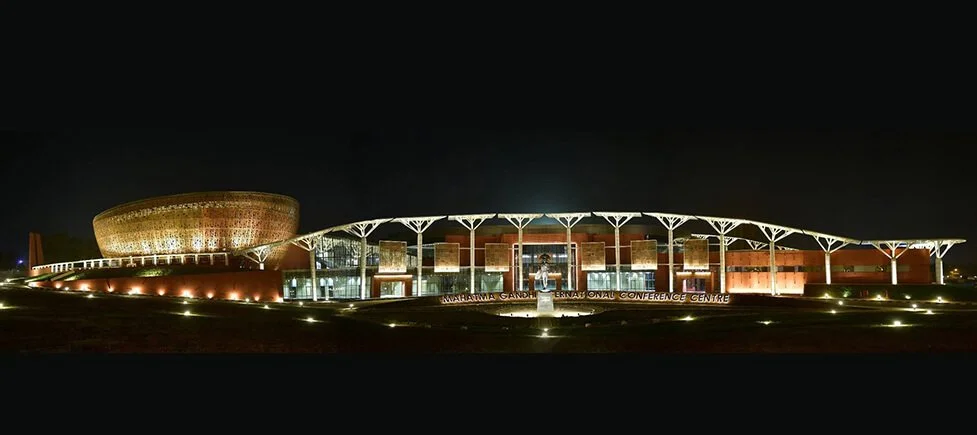
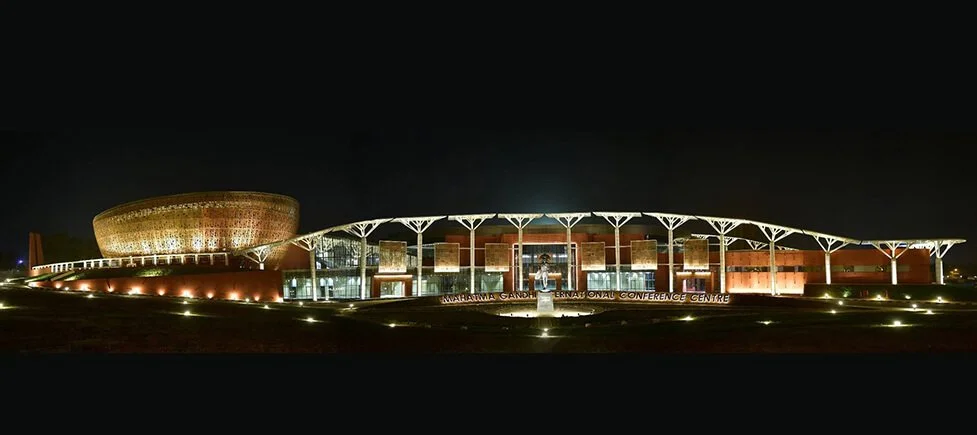
Mahatma Gandhi International Convention Centre (MGICC) in Niamey, Niger
Event Description
The Mahatma Gandhi International Convention Centre (MGICC) in Niamey, Niger stands as a compelling example of how contemporary architecture can reinterpret tradition, reflect cultural identity, and shape a meaningful civic place. Conceived and built by India as a symbol of friendship, the MGICC was delivered within an accelerated 14-month timeframe to commemorate the 150th anniversary of Mahatma Gandhi. Beyond its diplomatic significance, the project embodies a design approach rooted in Niger’s natural landscape and cultural heritage, articulated through a modern and globally legible architectural language that also incorporates subtle tributes to India.
Rather than relying on applied ornamentation, the MGICC embeds cultural meaning within its spatial and formal logic. The three primary buildings trace the flow of the Niger River, anchoring the complex to the geography that sustains Niamey. The Presidential Hall draws inspiration from the calabash—a traditional vessel central to communal life—while façade screens reference salt-pan patterns, and peripheral structural elements echo the branching forms of the baobab tree, an enduring symbol of the Sahel.
As a contemporary civic facility, the MGICC accommodates more than 3,300 guests across plenary, banquet, and multipurpose halls, alongside exhibition spaces honoring Mahatma Gandhi. The project balances ceremonial presence with functional flexibility, integrating cultural symbolism with environmental responsiveness suited to a hot, arid climate.
This session examines how the MGICC reconciles global expectations with local rootedness, illustrating how architects can translate cultural forms and geography into architecture that is expressive, functional, and socially resonant. The project offers broader lessons on shaping place through cultural continuity and cultural sensitivity within global architectural practice.
CES: 1 LU for AIA Members
Speakers
Abhin Alimchandani, Founder, Atelier VAMA
Annie Diana Ninan, Principal Architect, Atelier VAMA
Arti Verma, AIA, NCARB, LEED AP BD+C, Project Manager, Dynamik Design
Moderator
Andre Christensen, AIA; AIA Sub-Saharan Africa Vice-President; AIA International Country Representative of Namibia; Founder, Christensen Architects
Speaker Bios

Abhin C. Alimchandani is the Founder of Atelier VAMA and a visionary architect with over 30 years of experience across India, Africa, and the Middle East. An alumnus of the Academy of Architecture, Mumbai, and a French Government Scholar, he holds advanced double M.Phil-level qualifications from the École des Beaux-Arts, Paris in Conception in Architecture; and in History and Theory of Architecture.
Formerly Chairman of STUP Consultants, he expanded the firm’s global footprint to over 40 countries, delivering award-winning infrastructure and aviation projects. Under his leadership, Atelier VAMA continues to offer integrated design and engineering services with a strong emphasis on sustainability and innovation.
Abhin has led the design of over 250 iconic projects, including the Presidency in Ghana, the Parliament of Gambia, the Mahatma Gandhi International Conference Centre in Niger, Airport projects such as Hyderabad International Airport, Vijayawada & Jabalpur Airport; Atal Pedestrian Bridge over the Sabarmati River, Dhana Dhanya Cultural Complex in Alipore, Kolkata and the Sultan Qaboos Mosque in Oman, exemplify his ability to merge visionary aesthetics with technical precision.
He is a seven-time winner of the Construction World Top 10 Architects Award and recipient of the ENR Global Best Project Award. Abhin is widely respected for blending visionary aesthetics with technical precision to create culturally rooted, future-ready spaces.

Ar. Annie Diana Ninan is the Principal Architect at Atelier VAMA, bringing over two decades of experience across the Indian and international building industry. She holds a Master’s degree in Sustainable Environmental Design from the AA School of Architecture, London, and a Bachelor’s in Architecture from Pillai’s College of Architecture, Mumbai University. She is a distinguished recipient of the British Chevening Scholarship, J. N. Tata Endowment Award, Lotus Scholarship, and AA Bursary Award.
Her diverse portfolio includes public institutions, airports, hospitals, hotels, museums, and large-scale infrastructure projects. Notable works include the Seat of Government in Ghana, Mahatma Gandhi Convention Centre in Niger, Aerospace Museum in New Delhi, Patni Software Campus in Chennai, and the Hyatt Regency in Lucknow, alongside airport interior concepts for Vijayawada and Jabalpur. She has also contributed to the master planning of logistics hubs and educational campuses.
Annie has served as a full-time Assistant Professor at Dr. D.Y. Patil College of Architecture, Navi Mumbai. Her research paper on Low-energy Passenger terminal for airports was presented at PLEA 2008 in Dublin, establishing her expertise in sustainable and climate-responsive architecture. Her design ethos focuses on innovation, contextual sensitivity, and challenging conventional norms to create purposeful, future-ready environments.

Arti Verma is a registered architect in both the United States and India and currently serves as a Project Manager at Dynamik Design in Atlanta. She leads the design and delivery of multi-family, mixed-use, and affordable housing developments, guiding projects from early concept through construction while coordinating multidisciplinary teams and championing design excellence, sustainability, and community impact. In less than six years with the firm, she has advanced rapidly through multiple leadership roles, reflecting her strong technical and design leadership.
Arti holds a Master of Architecture from the Georgia Institute of Technology, Atlanta, and a Bachelor of Architecture from the University of Mumbai, India. Earlier in her career, she worked as an architect at STUP Consultants Pvt. Ltd. in Mumbai, where she contributed to several nationally and internationally significant infrastructure and cultural projects. During her time at STUP, she worked on major projects including the Mahatma Gandhi International Convention Centre in Niamey, Niger, Atal Pedestrian Bridge in Ahmedabad, the Aerospace Museum in New Delhi, and the Sindhudurg and Jabalpur Airport developments, gaining experience on large-scale public infrastructure and cultural architecture.
Beyond practice, Arti is active in professional leadership and mentorship. She serves as a Director on the Board of the Architecture Foundation of Georgia, and serves on the editorial committee of the Immigrant Architects Coalition. An NCARB Certificate holder and LEED-accredited professional, she is committed to advancing architecture that strengthens communities, reflects cultural identity, and contributes meaningfully to the built environment.

Moderator Bio
Andre Christensen completed his Master’s degree at Tshwane University of Science and Technology in Pretoria, South Africa, and practiced architecture in South Africa and the United Kingdom before settling in Namibia in 2008.
He served as President of the Namibian Institute of Architects from 2012 to 2014 and continues to serve as a board member, where he convenes the Institute’s Award of Merit programme. He has taught Architectural Design at Honours level at the Namibian University of Science and Technology and currently serves as an external moderator at the same institution.
He runs a small practice in Windhoek, Namibia, working on projects throughout the country. The firm undertakes a wide range of work, from residential to commercial projects. His particular passion lies in community projects, where thoughtful design solutions can make a world of difference.