
Photo by Space Center Houston, Apollo Mission Control Room
Two races are happening simultaneously. One is going down. One is going up. The design challenges are almost identical — and architecture has been largely absent from both.
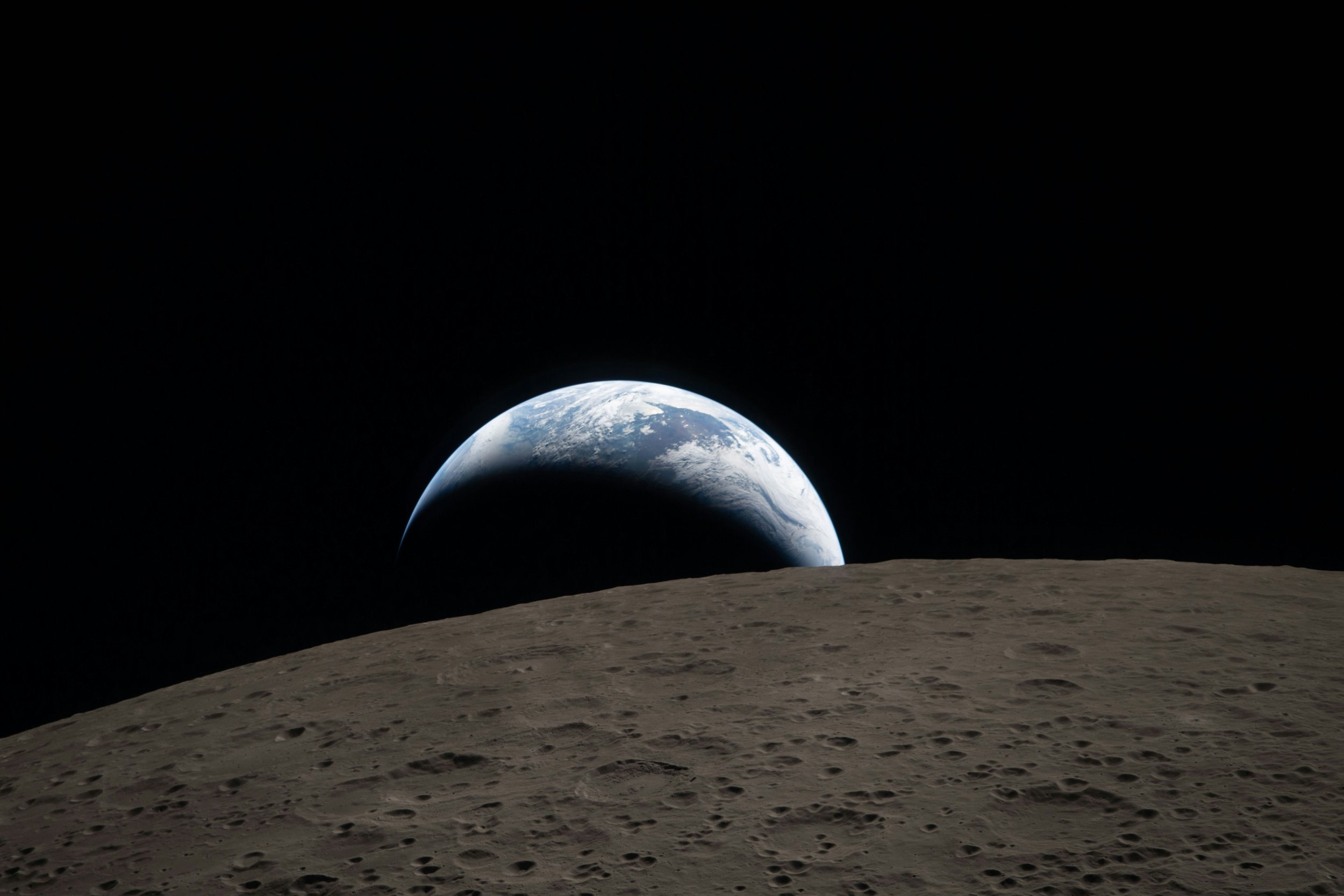
Photo by NASA
Somewhere in the South China Sea, 2,000 meters below the surface, construction has begun on what may be the most consequential building project of this decade. China’s deep-sea research station, already dubbed a deep-sea space station by the scientific community, is scheduled to be operational by 2030, housing six scientists on month-long missions in one of the most hostile environments on Earth. Meanwhile, at NASA’s Johnson Space Center in Houston, engineers are finalizing the habitat designs for a permanent lunar base under the Artemis program. Two entirely different frontiers. Two almost identical problems.
Both environments are characterized by extreme pressure differentials, total isolation from resupply, closed-loop life support systems, long-duration human occupancy, and the near-total absence of natural light cycles. The engineering solutions converge remarkably, modular construction, pressure-resistant shells, redundant systems, micro-grid power. Yet the disciplines shaping these structures remain largely the same ones that have always designed extreme-environment infrastructure: engineers and scientists. Architects, for the most part, are not in the room.
That needs to change; not because engineering is flawed, but because engineering alone has never been enough to create places where people can truly live.
TWO FRONTIERS, ONE DESIGN PROBLEM
It is worth being precise about what new frontier means here, because the conversation tends to dissolve into speculation. These are not concept proposals or architectural competitions. They are funded, approved, under-construction realities.
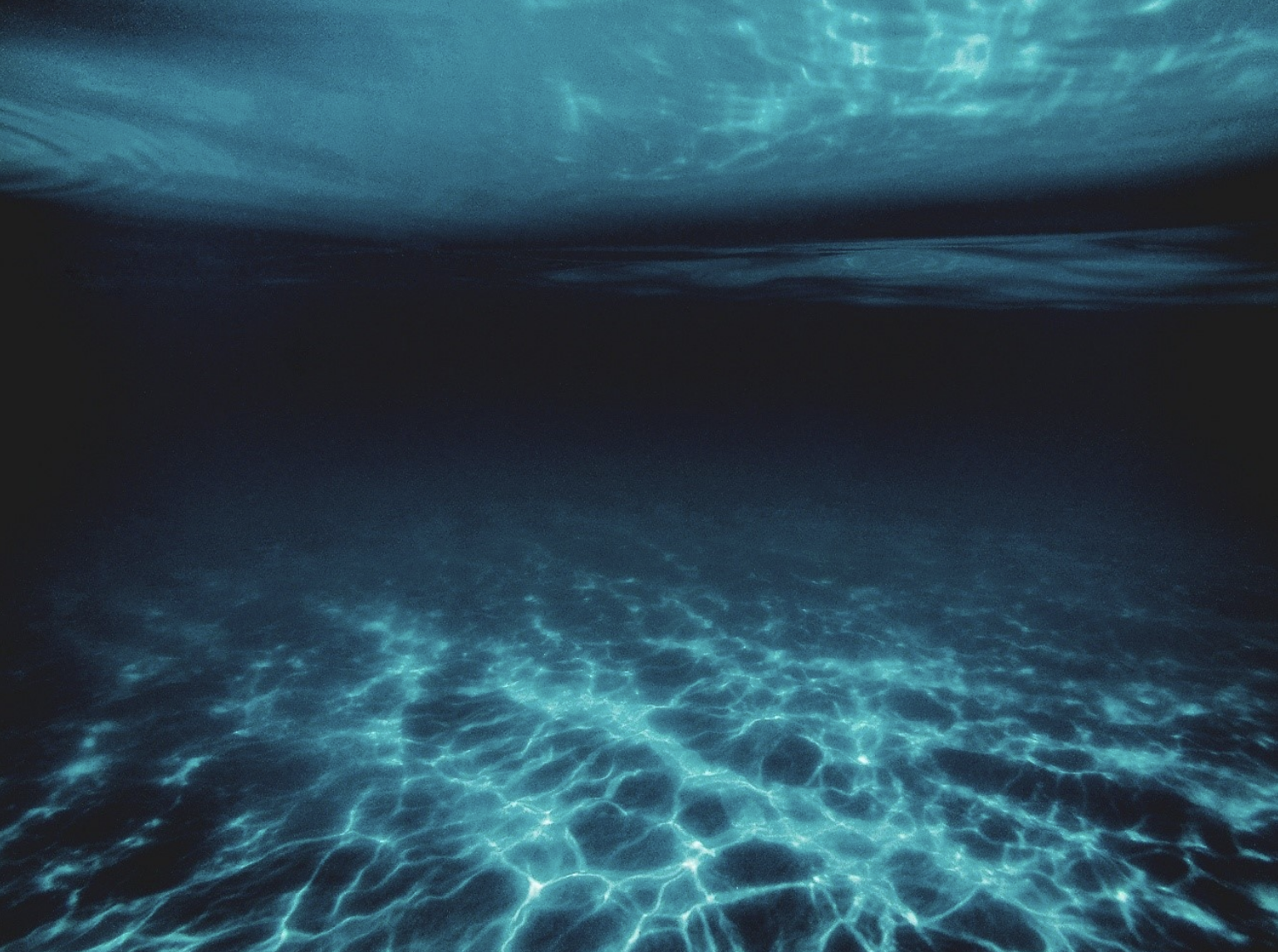
China’s South China Sea station will sit at 6,560 feet depth, targeting the cold-seep ecosystems rich in methane hydrates — frozen reservoirs of energy so vast that estimates place them at nearly double the energy potential of all known fossil fuel deposits combined. The station will be supported by a network of autonomous submersibles, seabed observatories and fiber-optic infrastructure already threaded across the ocean floor. Construction began in 2025, with a four-year build phase preceding a year of operational testing in 2030. The US, through the Proteus Ocean Group, is developing a competing initiative off the coast of Curacao, a network of international subsea habitats designed for long-term marine research.
Above the surface, far above, NASA’s Artemis program has formally added an initial lunar surface habitat and a cargo lander to its Moon to Mars architecture. Foster + Partners, ICON, and a cohort of aerospace firms are actively developing 3D-printed habitat prototypes using lunar regolith as a construction material. NASA’s Mars Dune Alpha, a fully 3D-printed analogue habitat in Houston, completed its first year-long human occupancy simulation in July 2024. The timeline from concept to inhabited structure is compressing rapidly.
The race metaphor is unavoidable — and not merely poetic. It carries real geopolitical weight. China’s deep-sea station also reinforces territorial claims in disputed waters. The architecture of these frontier structures is inseparable from the politics of who builds them, where, and first.
Deep Ocean, Photo by Jonathan Borba on Unsplash
THE SAME PROBLEM, TWICE
Strip the context away; no water, no vacuum, no regolith, and the design brief for a deep-sea habitat and a lunar habitat are structurally near identical. Designers working on both environments are confronting the same list: a pressure boundary that is the difference between life and death; no natural light reaching occupants in any meaningful way; complete dependency on closed-loop systems for air, water and waste; total isolation from resupply for weeks or months at a time; and a crew living, working, sleeping, and slowly fraying psychologically in a confined space they cannot leave.
This is not a casual analogy. Academic research in extreme environment design now formally groups deep sea, Moon and Mars habitats into a single category, noting that design experiences from space stations and polar research stations, such as modular construction and closed-loop life support systems, can provide technical parallels across all three. SAGA Space Architects — the Copenhagen studio perhaps most seriously engaged with this overlap — has built a lunar-tested habitat in the Arctic, designed an underwater structure at the bottom of Copenhagen harbor, and developed training facilities for the European Space Agency. They treat these environments as a single design discipline.
The modular approach is emerging as the dominant structural language across both frontiers. DEEP’s Sentinel system — a British-designed undersea habitat currently in development — uses pressure-resistant modules that can be reconfigured and relocated without surfacing. NASA’s lunar habitat concepts use inflatable and rigid hybrid modules that can be autonomously assembled by robots before crew arrival. The design logic is the same: small, interchangeable units that can be launched, lowered, or printed on-site, then connected and expanded incrementally.
What we learn on the ocean floor, we will build on the Moon. The engineering is already speaking that language. Architects need to join the conversation.
This cross-pollination is not theoretical. The materials science developed for deep-sea pressure vessels have directly informed spacecraft hull research. Life support systems tested in undersea habitats — Aquarius Reef Base, being the most extensively studied — have fed into ISS operational protocols. The pipeline flows in both directions. Which makes the absence of architectural thinking from both conversations more conspicuous.
THE GAP HOLLYWOOD ALREADY CLOSED
There is an uncomfortable irony at the center of this discussion. The spaces we imagine humans inhabiting beyond Earth, in film, in the collective visual culture that shapes how the public understands these frontiers are far more considered than the real ones. The spacecraft in Interstellar, the corridors of the Discovery in 2001: A Space Odyssey, the bridge of the Enterprise in Star Trek. These are environments with spatial hierarchy, material warmth, light that communicates time of day, and a legible logic to how space is organized. A viewer understands immediately where rank sits, where rest happens, where work happens. The architecture is doing communicative work.
Now look at the interior of the International Space Station. The ISS is a marvel of engineering — but it is visually and spatially incoherent. Cables run in every direction. Surfaces are covered entirely in Velcro patches, equipment brackets and notices. There is no spatial hierarchy — no distinction between a corridor and a room, no visual signal of where work ends and recovery begins. It looks, in the most literal sense, like the inside of a server rack. It functions. It does not inspire.
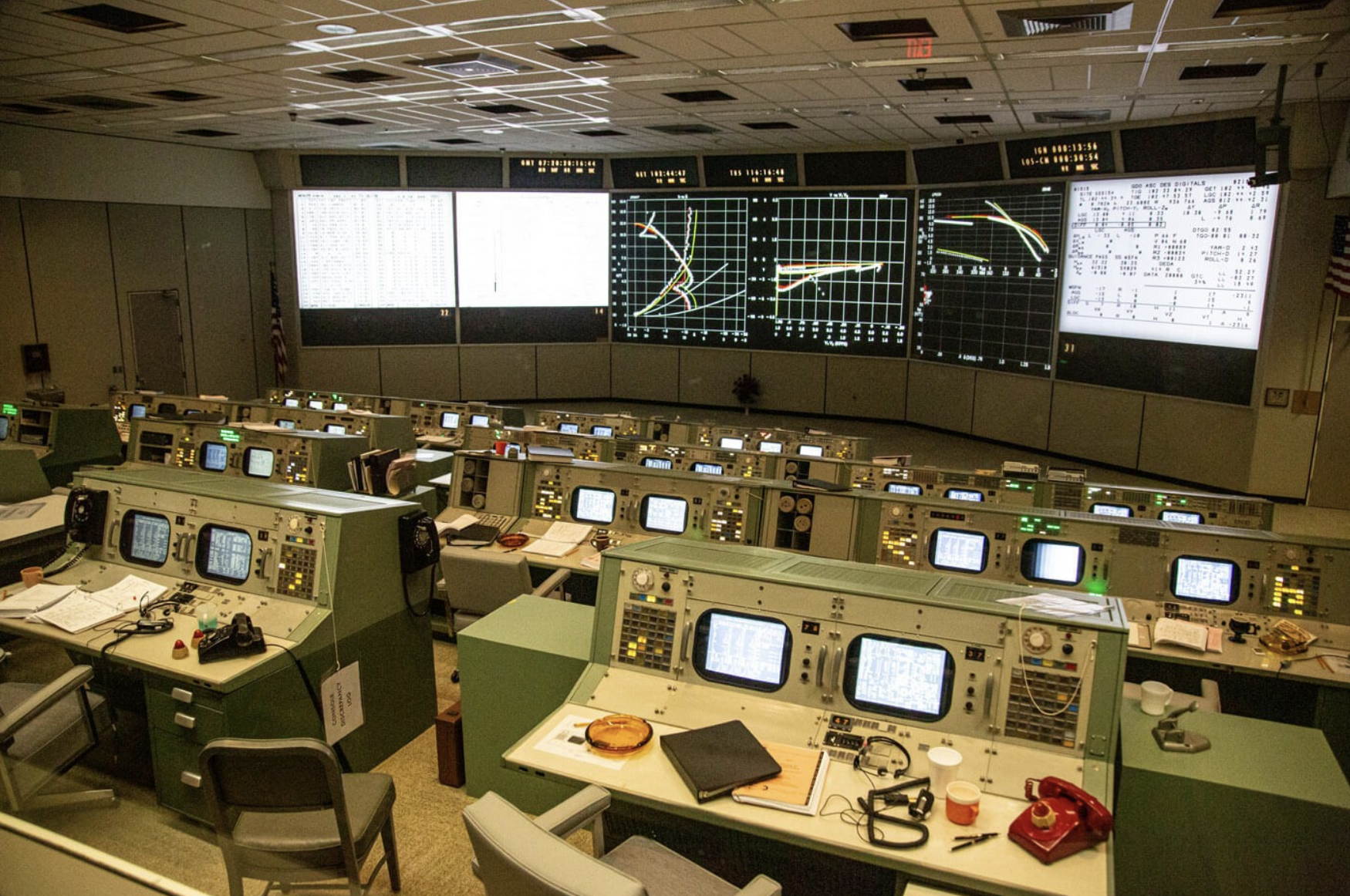
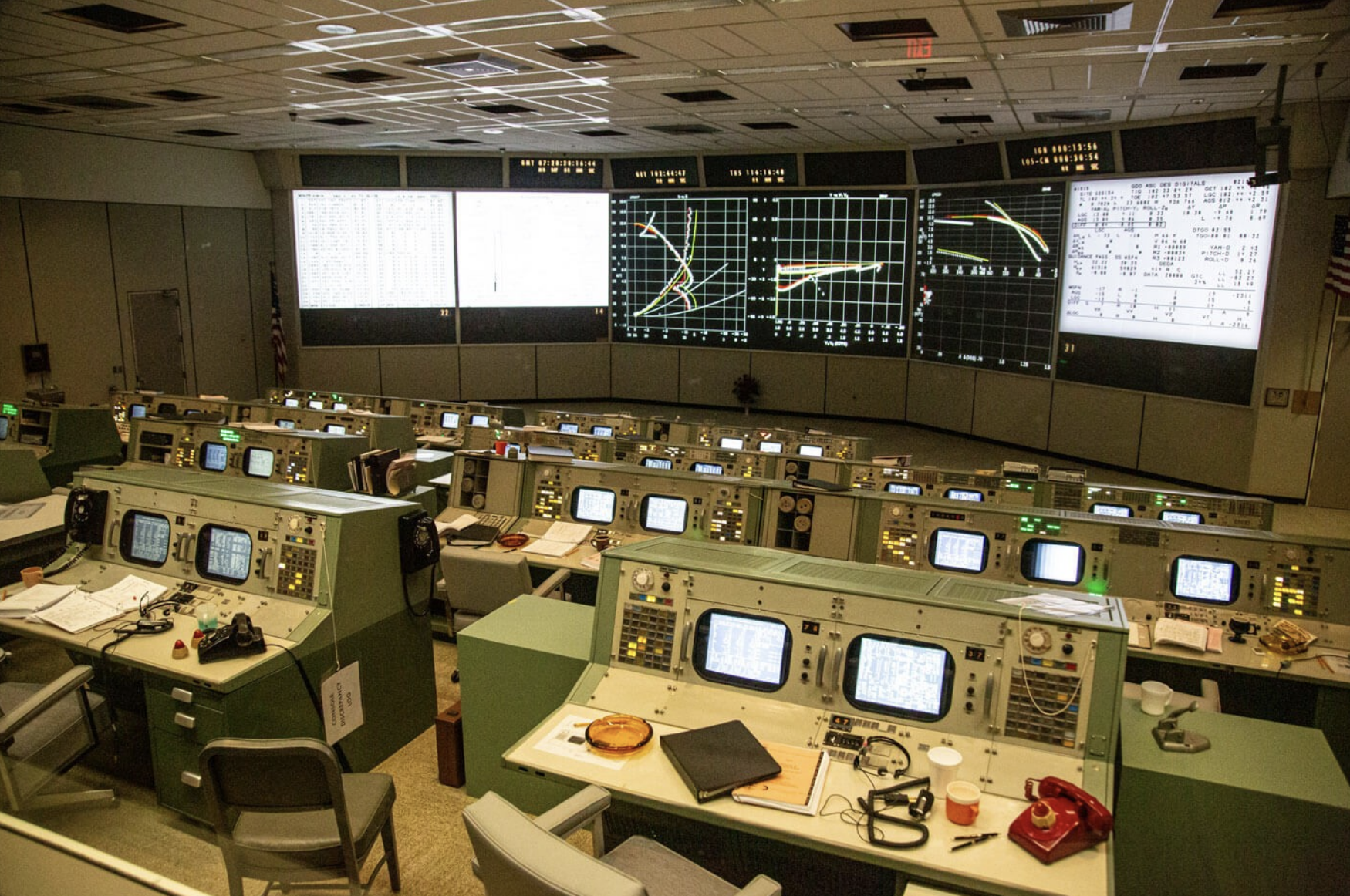
The contrast sharpens further when you look at mission control. Apollo’s Mission Control Center in Houston, now a protected historic landmark, restored to its 1969 configuration, had visual authority. Low ambient light, tiered rows of consoles, a singular focal wall of screens, a spatial arrangement that communicated order and concentrated attention. Visitors to its restoration today describe feeling the weight of what happened there. The space holds meaning.
The Artemis-era control rooms, technologically far superior in every measurable way, look like any open-plan office in a mid-tier technology company. Rows of identical workstations under flat overhead lighting, generic acoustic ceiling tiles, display walls that feel additive rather than integral. Nothing about space communicates the stakes of what is being done there. The upgrade in computing power has been accompanied by a regression in spatial intelligence.
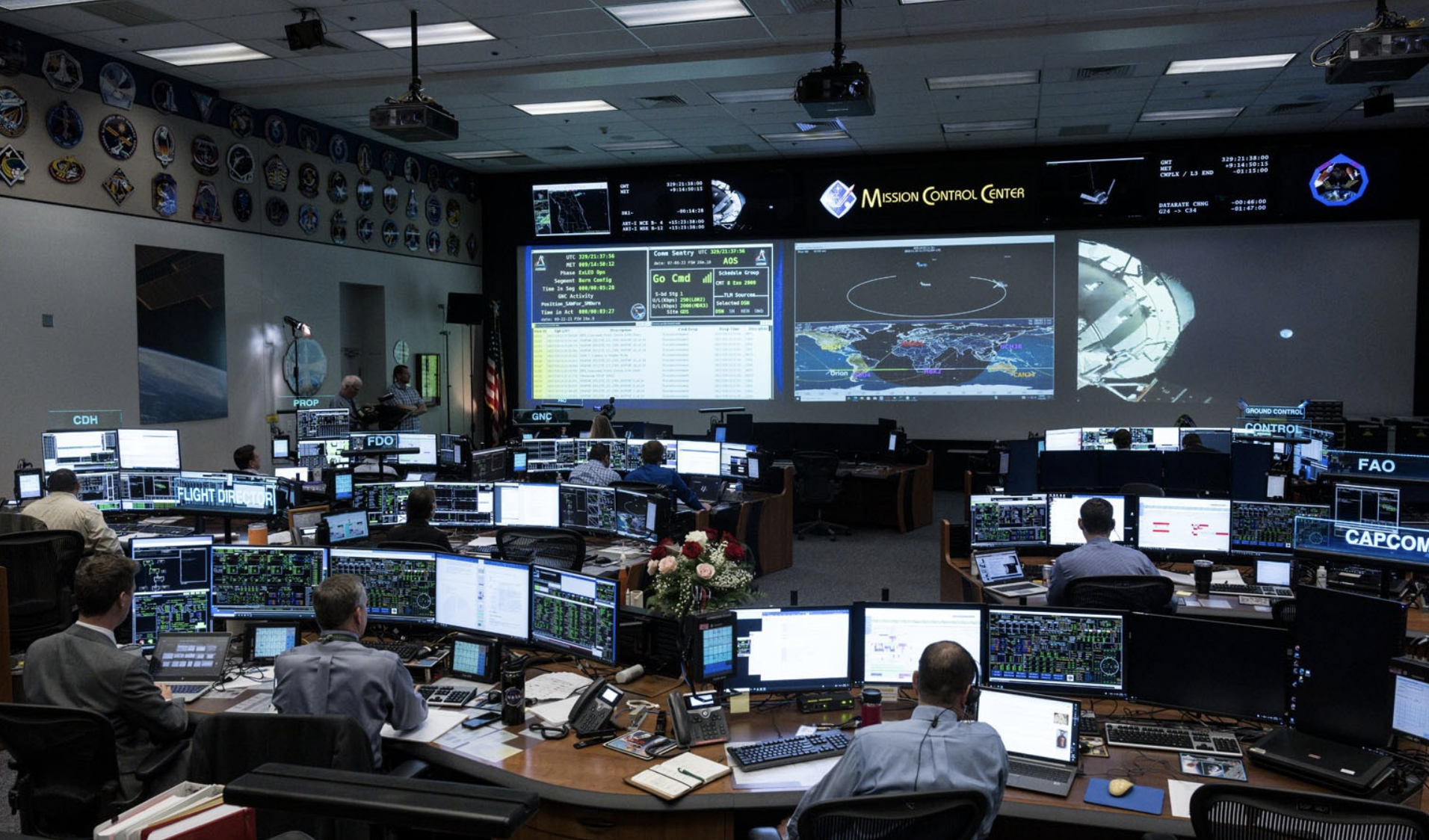
A view of the White Flight Control Room at NASA's Johnson Space Center as Artemis-1 flight controllers are pictured during Orion's distant retrograde orbit insertion. Coursey, Facebook page NASA’s Johnson Space Center
This is not aesthetics for its own sake. Humans are profoundly, measurably affected by the spaces they inhabit. Environment shapes concentration, mood, fatigue, error rates and long-term psychological wellbeing particularly under conditions of confinement and stress. SAGA Space Architects have noted that the most prescribed medication on the ISS is sleeping pills, not because the engineering of sleep systems has failed, but because the light environment does not align with human circadian biology. That is a design failure masquerading as a medical problem.
In a deep-sea station at 2,000 meters, where no natural light penetrates and crew rotate through month-long missions, this failure compounds. On a lunar base, where the sun rises and sets on a 29.5-day cycle bearing no relationship to human sleep rhythms, it compounds further. The longer the mission duration, the more the quality of the designed environment determines the quality of the science and potentially the survival of the people conducting it.
Movie production designers understand this instinctively. They are hired specifically to answer the question: how does this space make the person inside it feel, and what does it communicate to everyone who sees it? That is, in essence, the architect’s question. The fact that fictional space habitats routinely answer it better than real ones is not an accident of budget or technology. It is the direct consequence of who was, and was not, invited to the design table.
FORM FOLLOWS SCIENCE
The argument for architecture’s role in the new frontiers is sometimes framed as a conflict: aesthetics versus engineering, human experience versus structural necessity. That framing is both outdated and counterproductive. The more interesting question is what becomes possible when the two work in genuine collaboration and what new tools are making that collaboration more achievable than it has ever been.
AI-assisted generative design is already reshaping what is possible at the intersection of architecture and extreme engineering. Parametric tools can now optimize a structural form simultaneously for pressure resistance, internal spatial flow, natural light simulation, material efficiency and psychological habitability metrics problems that previously required sequential specialist handoffs, each introducing compromise. A pressure hull that is also spatially coherent is no longer a contradiction in terms; it is a constrained optimization problem that computational design tools are increasingly well-equipped to solve.
3D printing with local materials, regolith on the Moon, and potentially mineral-rich seabed material in deep-sea construction, removes one of the fundamental constraints that has historically kept architectural ambition out of extreme environments: the impossibility of transporting complex building components to inaccessible locations. NASA’s MMPACT project is already demonstrating large-scale autonomous robotic printing using simulated lunar surface material. ICON’s Olympus system uses high-powered lasers to melt regolith into ceramic-like structural components. These are not speculative technologies. They are being tested now, and the design language enables organic, non-orthogonal, pressure-optimized forms that aligns far better with architectural thinking than with standard construction practice.
The critical point about AI in this context is that it is an enabler of collaboration, not a substitute for disciplinary expertise. The sleeping pill problem on the ISS cannot be solved by an algorithm that has not been asked the right question. Asking the right question, what does long-term habitation in this environment require of the space, is an architectural question. AI gives architects and engineers the tools to answer it together, at a speed and resolution that were previously impossible. What it cannot do is replace the decision to ask it in the first place.
WHO SETS THE RULES AT THE FRONTIER?
There is one dimension of this conversation that architecture has historically been reluctant to engage with directly, and which the new frontiers make unavoidable: governance. Pioneering new environments means operating in the absence of established codes, regulations and precedents. The people who design the first structures in a new environment are, implicitly, setting the standards that everyone who follows will build to.
The ocean floor and the lunar surface share this quality. There is no binding global standard for habitation structures on the seabed below national jurisdictions. There is no building code for the Moon. The International Seabed Authority governs deep-sea mining licenses, but the architecture of habitation structures falls into a governance gap that is only beginning to be addressed. China’s deep-sea station is simultaneously a research facility and a territorial assertion. The design of that station, what it signals, what it establishes as normal, what standards it sets by precedent, is not a neutral technical matter.
It is also worth observing that the nation’s most loudly associated with sustainability and green architecture on land are often among the least scrutinized actors in these new frontiers. The gaps in international regulation that allow deep-sea mineral extraction with limited environmental assessment, or lunar resource utilization without binding conservation frameworks, tend to benefit precisely the most technologically advanced actors. Architecture’s engagement with the new frontiers cannot be limited to designing better sleeping quarters. It must extend to the question of what values are embedded in these structures from the outset and who gets to decide.
CONCLUSION: SHOWING UP EARLY
Louis Sullivan’s dictum, form follows function, defined a century of architectural thinking by insisting that the shape of a building should be determined by what it needs to do. The new frontiers propose a refinement: form should follow science. The design of deep-sea and lunar habitats must be determined not by aesthetic convention or engineering default, but by what we know from neuroscience, biology, psychology and ecology; about what human beings need to function, create and survive over long durations in extreme environments.
That knowledge exists. The research is there. What has been missing is the institutional will to bring it to bear on structures that are being designed and built right now, in real time, for occupancy within this decade.
The window is open. China’s deep-sea station breaks ground this year. NASA’s lunar habitat program is advancing. The production designers who make fictional space feel more humane than the real thing are not doing something mysterious, they are applying design thinking to human experience, which is what architects are trained to do. The question is whether the profession shows up as a full partner in defining these frontiers, or arrives, as it so often has, to decorate what engineers have already built.
The frontier does not wait for a late invitation.
Author: Amar Hromo, AIA International
Interested in contributing? We welcome AIA International members to share thoughtful articles for future editions of the AIA International newsletter. Send your submission to our Newsletter Editor.